Bridging Cultures: Karl Thone's Legacy Meets Malaysian Music Heritage
Orchestra & The Arts
•
October 20, 2025
Bridging Cultures: Karl Thone's Legacy Meets Malaysian Music Heritage
Orchestra & The Arts
•
October 20, 2025
Share
Copy link
Share
Copy link
When German classical composition and musicians meets Malaysian musical heritage and musicians, the result is more than a concert. It's cultural dialogue. The Karl Thöne 101st Anniversary Festival at DBKL Auditorium proved exactly that, blending Thöne's string orchestra works with a stunning orchestral arrangement of P. Ramlee's Getaran Jiwa in an evening that honored both traditions with equal reverence.
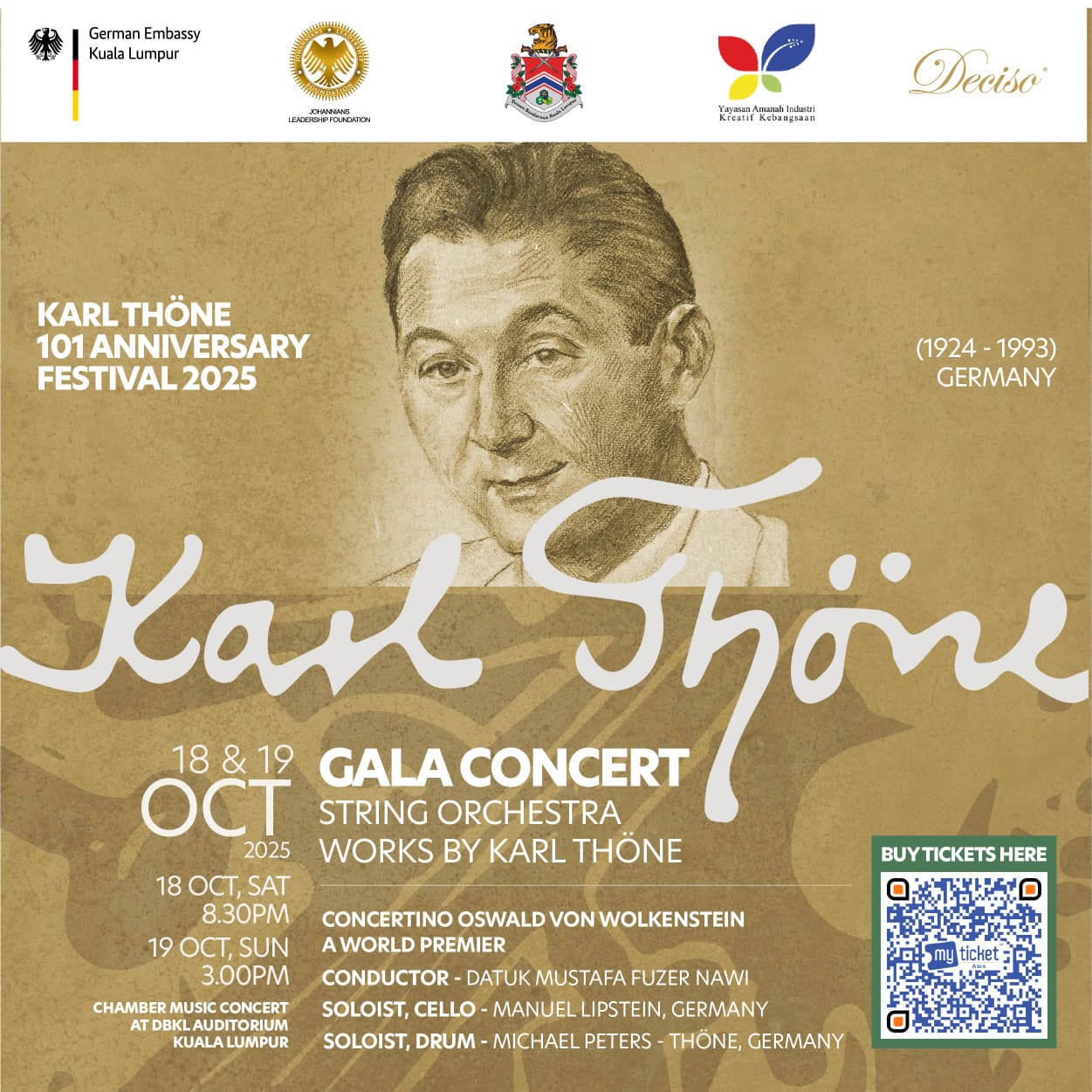
The Karl Thöne 101st Anniversary Festival brought together German classical tradition and Malaysian musical heritage in an intimate string orchestra performance at DBKL Auditorium, Kuala Lumpur. Featuring works by the late German composer Karl Thöne alongside a classical arrangement of P. Ramlee's beloved Getaran Jiwa, this gala concert demonstrated the power of cross-cultural collaboration. With German cellist Manuel Lipstein premiering Thöne's Concertino Oswald von Wolkenstein and conductor Datuk Mustafa Fuzer Nawi leading the ensemble, the evening honored both Thöne's compositional legacy and his vision of music as a bridge between nations.
Passacaglia and Timpani: Thöne's Dramatic Opening
The evening opened with Passacaglia in F for String Orchestra, Oboe & Timpani, an immediate declaration of intent. Featured Timpanist is performed by Karl Thöne's grandson, Ilyas Thöne Mustafa Fuzer. The passacaglia form, with its repeating bass line and accumulating variations, creates natural dramatic momentum, and this arrangement exploited that structure brilliantly. The timpani punctuated the texture with commanding authority while the oboe wove lyrical lines above the string foundation. This was flamboyant writing, unafraid of drama and dynamic contrast. The piece established the concert's character: this would be string orchestra music with orchestral ambition.
The second work, Mattinata for String Orchestra and 2 Flutes, shifted the mood entirely. Here the flutes introduced a pastoral, almost aria-like quality, their paired voicing creating harmonic richness as the music modulated into brighter, more joyous territory. The major mode felt like sunrise after storm, still sophisticated in its harmonic vocabulary but unmistakably celebratory. This is where Thöne's compositional voice emerged most clearly: European formal structure infused with melodic warmth that never descended into sentimentality.
Then came an unexpected turn: the CM Finale for String Orchestra, 2 Flutes & Drum, featuring Michael Peters-Thöne on percussion, Karl Thöne's son-in-law. The addition of drum kit to string orchestra forces could easily feel gimmicky, but Peters-Thöne's energetic performance integrated seamlessly with the strings rather than overpowering them. His rhythmic vocabulary drew from both classical percussion tradition and contemporary approaches, creating textural interest that expanded the ensemble's sonic palette. It's rare to hear this instrumentation blend so organically, a testament to both the arrangement and the soloist's sensitivity to ensemble dynamics.
Cross-Cultural Dialogue: P. Ramlee Meets Classical Orchestration
The evening's emotional core, however, belonged to P. Ramlee's Getaran Jiwa, arranged for string orchestra by Azhad Sulaiman. P. Ramlee (1929-1973) remains one of Malaysia's most beloved composers and filmmakers, a figure whose work defined Malaysian popular music in the mid-20th century. To hear Getaran Jiwa reimagined through Western classical orchestration was to witness cultural translation at its most thoughtful.
Azhad Sulaiman's arrangement employed sophisticated string writing techniques: imitative counterpoint between violin sections, strategic use of divisi to thicken harmonic density at climactic moments, and careful attention to the melody's original phrasing even as it migrated through different registers. The result respected both traditions. The tune remained recognizably Ramlee's, but the orchestral treatment gave it new emotional dimension. This wasn't simply "classical music plays pop song." It was genuine cross-cultural musical dialogue.
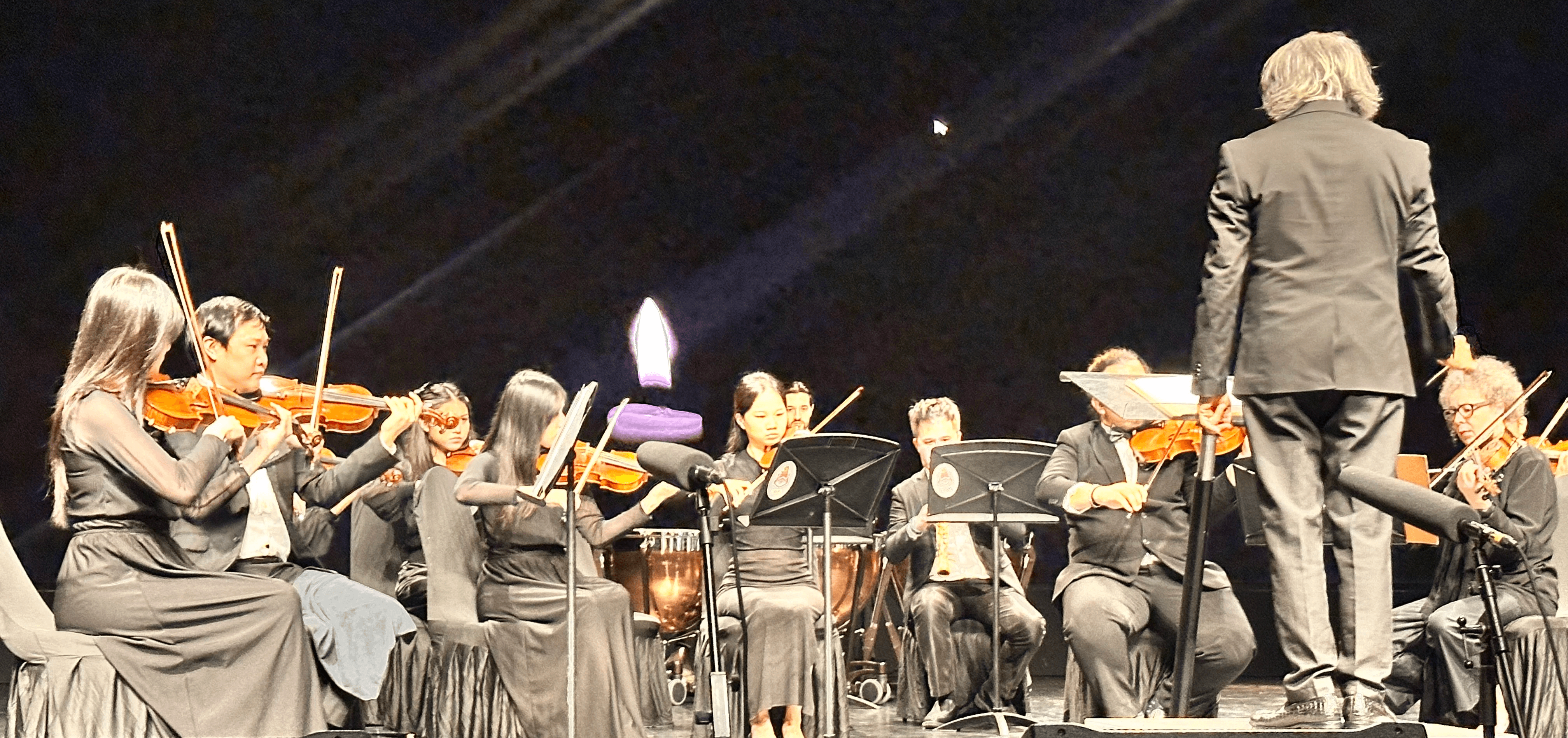
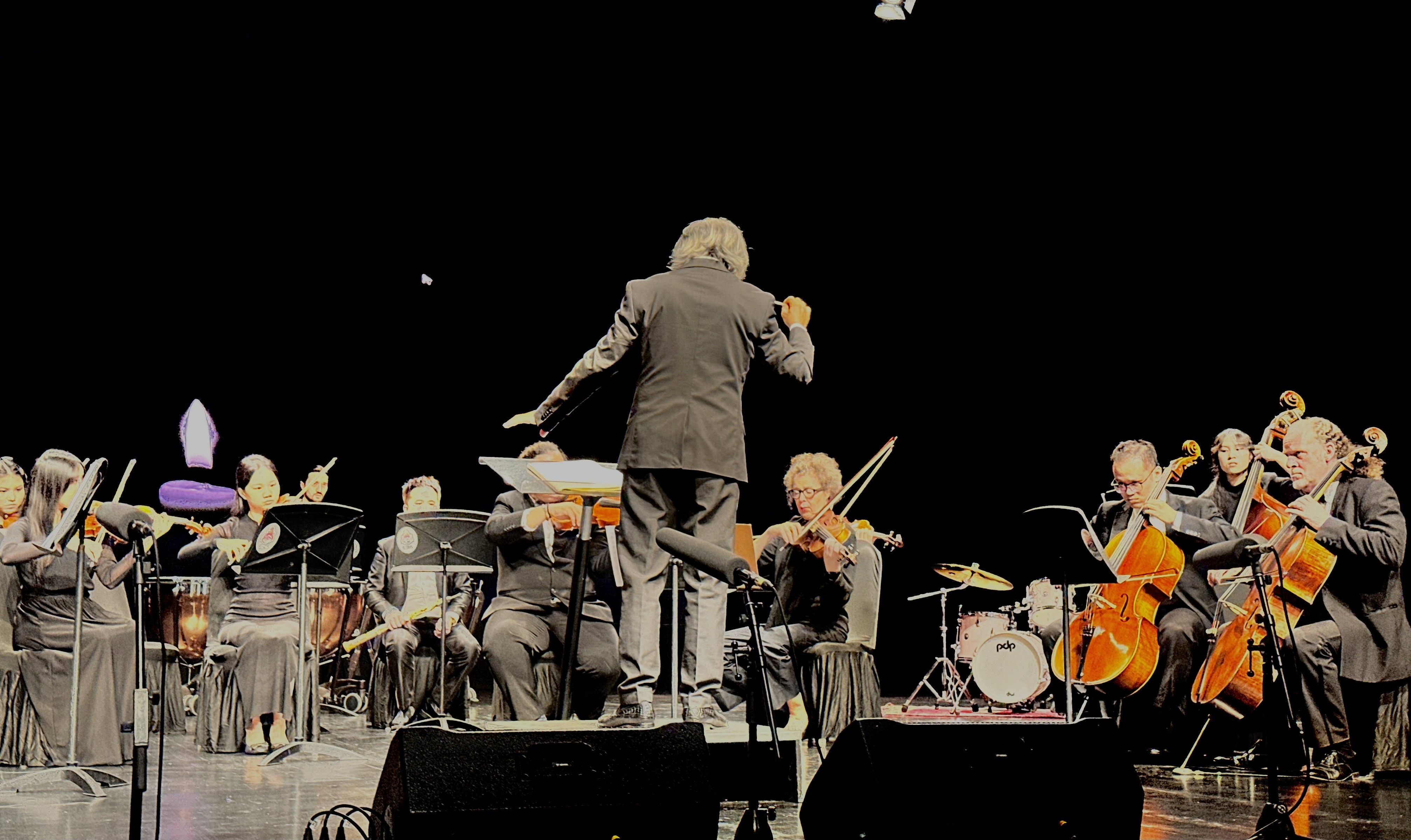
Photos; Datuk Mustafa Fuzer Nawi, son-in-law of the late Karl Thöne conducting the strings orchestra of Malaysian and German musicians.
World Premiere: Lipstein's Concertino Performance
The concert concluded with the Concertino Oswald von Wolkenstein for Cello and String Orchestra, a world premiere featuring German cellist Manuel Lipstein. Lipstein, trained at elite German conservatories, brought technical precision and interpretive depth to Thöne's concertino form, a scaled-down concerto that emphasizes intimacy over virtuosic display. His tone throughout the lyrical passages demonstrated the control expected from European conservatory training, while his dynamic range in the more dramatic sections revealed why he was chosen for this premiere. The cello's voice, so close to human expression, carried Thöne's musical language with eloquence. The cello used by Manuel is well a crafted handmade by Malaysian Luthier, Tan Chin Seng. He won a bronze Medal in Italy for Violin making competition recently.
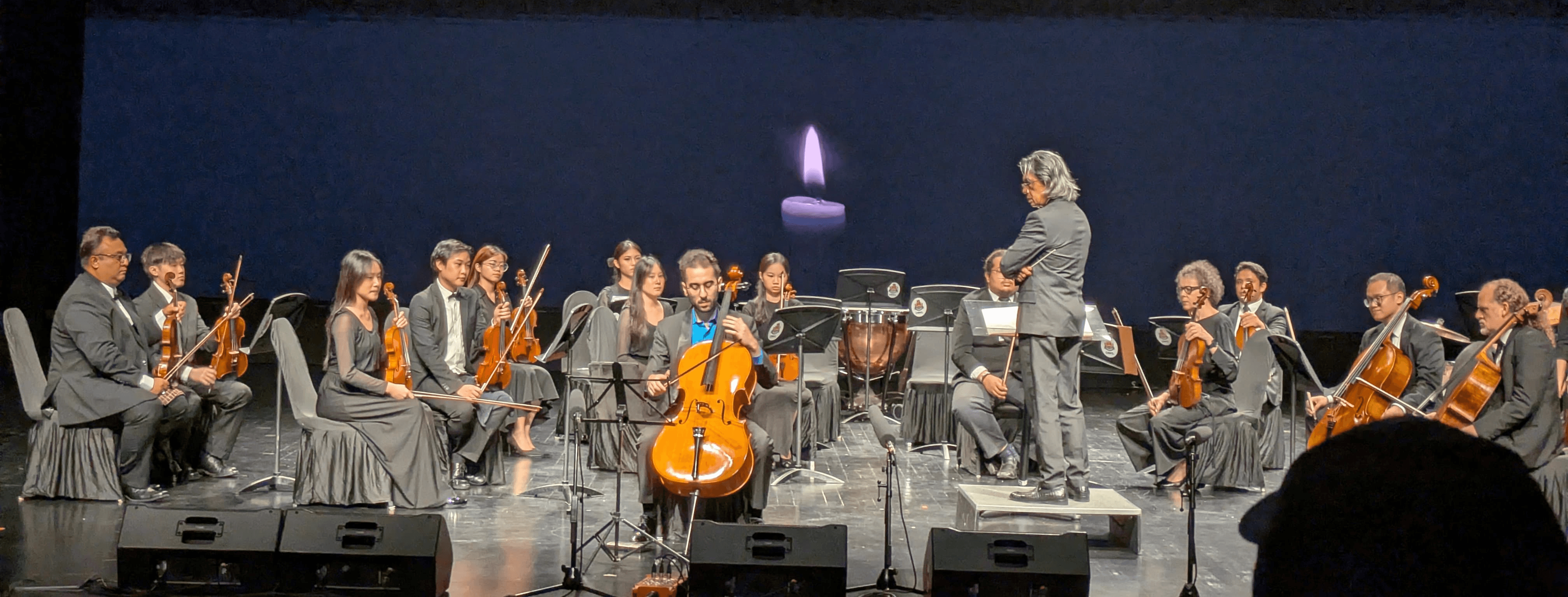
Conductor Datuk Mustafa Fuzer Nawi guided the ensemble through the evening's diverse program with assured clarity, drawing distinct character from each work while maintaining cohesive flow. The performance united Malaysian and German musicians in artistic partnership, featuring German soloists Manuel Lipstein on cello and Michael Peters-Thöne on drum. Eight violins divided between first and second sections, supported by viola, two cellos, and double bass, formed the string foundation, while two flutes, oboe, and timpani added color and dramatic weight. This blend of forces created textures both transparent and substantial, showcasing the collaborative spirit at the heart of the festival.
What elevated this concert beyond mere anniversary commemoration was its cultural positioning. With the German Embassy representative in attendance, the event represented more than diplomatic courtesy. It embodied artistic collaboration across cultures. Karl Thöne's German compositions and P. Ramlee's Malaysian classic shared the same program not as novelty, but as evidence that musical traditions can coexist and enrich one another.
The combination might seem unlikely on paper: German concert music and Malaysian popular song, Western classical forms and Southeast Asian melody. Yet both Thöne and Ramlee understood something fundamental about music: that emotional truth transcends national boundaries, that carefully crafted melody resonates regardless of its stylistic origins.
This intimate gala demonstrated why Thöne's legacy matters beyond his own compositions. As documented in his work building Malaysia's symphony orchestra infrastructure, Thöne believed in music's capacity to connect rather than divide. This anniversary concert, blending his compositions with Malaysian heritage through thoughtful arrangement and performance, honored that vision more authentically than any standard memorial program could.
String orchestra performance at its best creates conversation between instruments, between performers and audience, between traditions. The Karl Thöne 101st Anniversary Festival achieved exactly that, proving that cultural exchange through music remains one of the most eloquent forms of international dialogue.
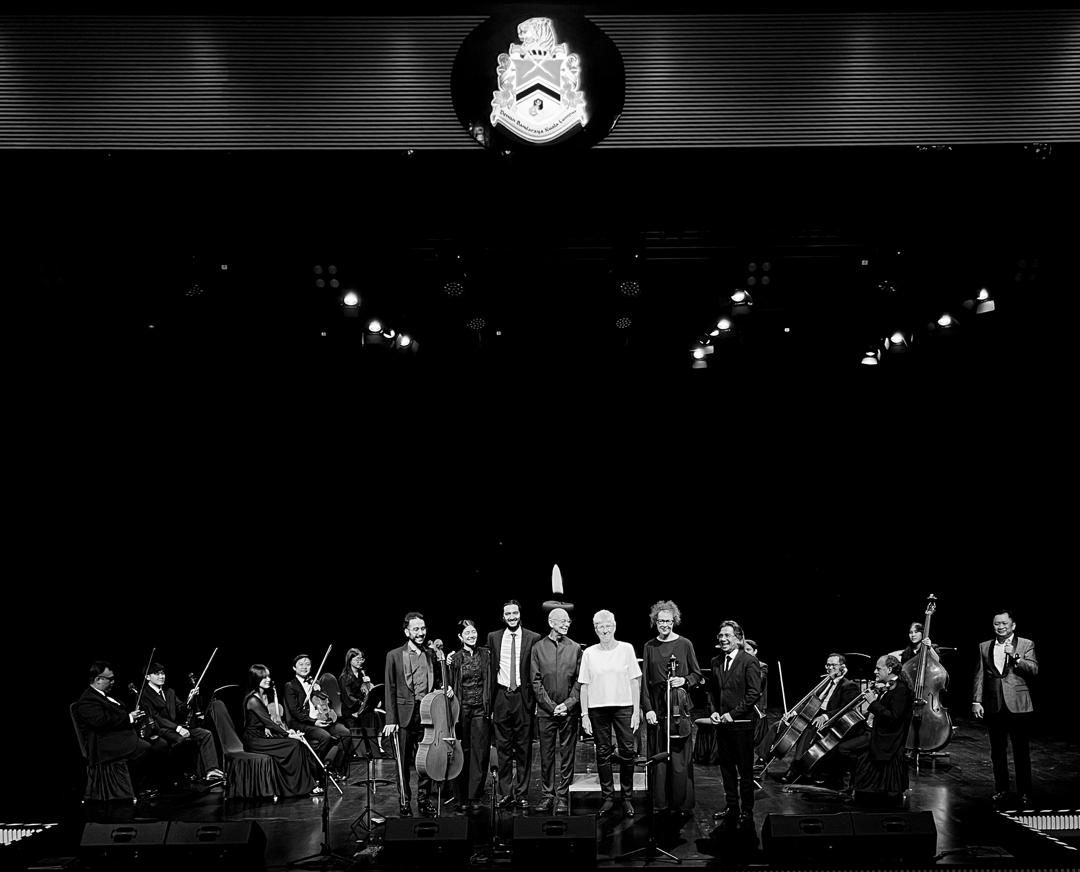
The Thöne family joins conductor Datuk Mustafa Fuzer Nawi and the string orchestra for the curtain call. Pictured: Datin Veronica Thöne - (violist and daughter) and Michael Peters Thöne (soloist drum and son-in law)
Photos | Azman Karib
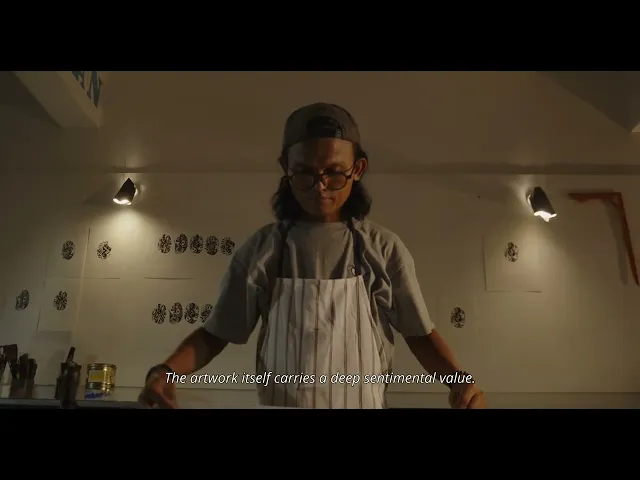
An short documentary video about Karl Thöne's work of arts.
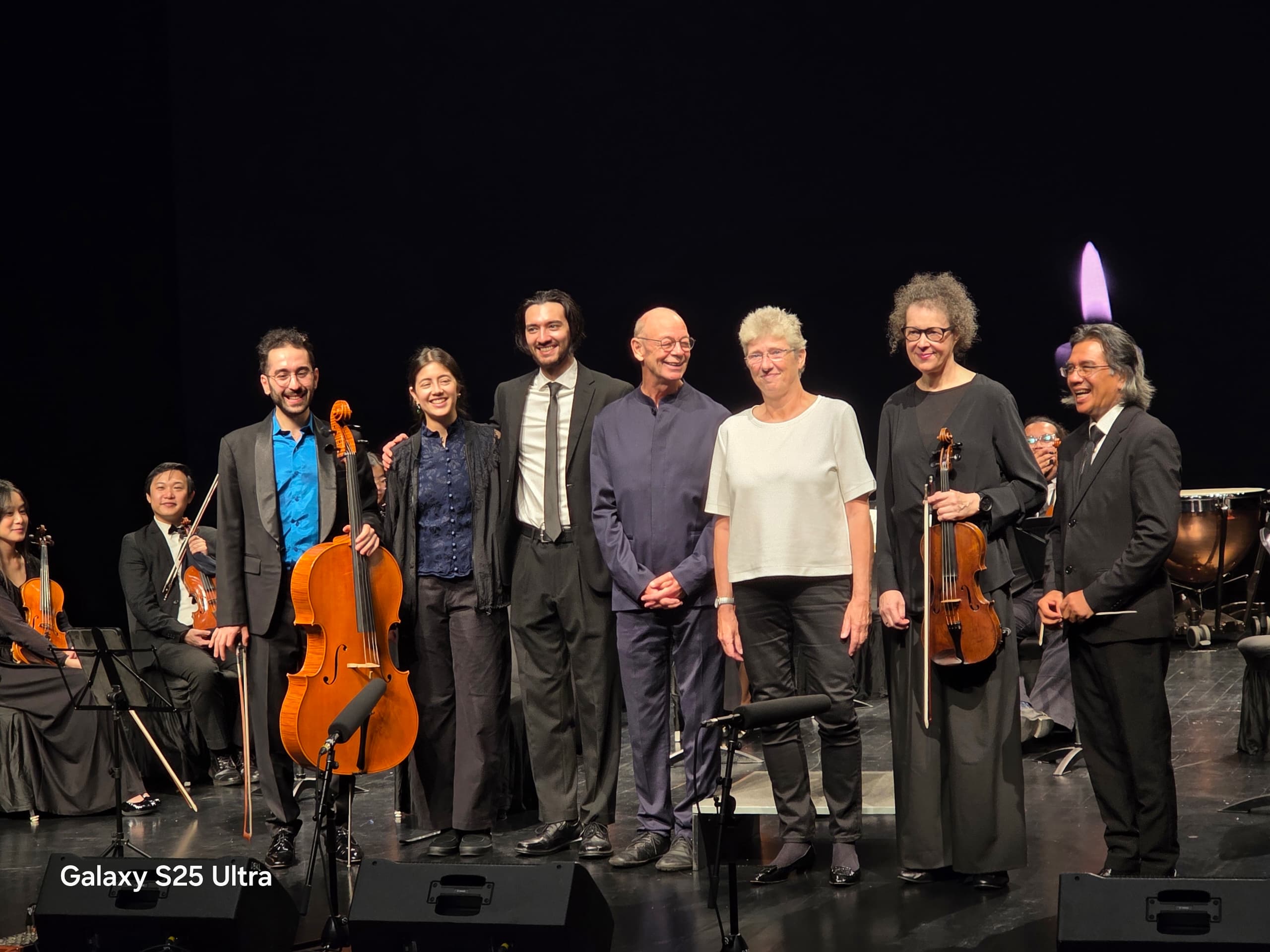
The family of legacy composer Karl Thönes
About the Coverage
This review is part of 22Muse Media's classical and jazz concert coverage. For professional event coverage, artist features, and performance reviews, contact us at editor@22musemedia.com or visit www.22musemedia.com
22MuseMedia provides tailored coverage for concerts, recitals, festivals, and cultural events across classical, jazz, and contemporary music.
Connect with us: LinkedIn: 22MuseMedia
The Karl Thöne 101st Anniversary Festival brought together German classical tradition and Malaysian musical heritage in an intimate string orchestra performance at DBKL Auditorium, Kuala Lumpur. Featuring works by the late German composer Karl Thöne alongside a classical arrangement of P. Ramlee's beloved Getaran Jiwa, this gala concert demonstrated the power of cross-cultural collaboration. With German cellist Manuel Lipstein premiering Thöne's Concertino Oswald von Wolkenstein and conductor Datuk Mustafa Fuzer Nawi leading the ensemble, the evening honored both Thöne's compositional legacy and his vision of music as a bridge between nations.
Passacaglia and Timpani: Thöne's Dramatic Opening
The evening opened with Passacaglia in F for String Orchestra, Oboe & Timpani, an immediate declaration of intent. Featured Timpanist is performed by Karl Thöne's grandson, Ilyas Thöne Mustafa Fuzer. The passacaglia form, with its repeating bass line and accumulating variations, creates natural dramatic momentum, and this arrangement exploited that structure brilliantly. The timpani punctuated the texture with commanding authority while the oboe wove lyrical lines above the string foundation. This was flamboyant writing, unafraid of drama and dynamic contrast. The piece established the concert's character: this would be string orchestra music with orchestral ambition.
The second work, Mattinata for String Orchestra and 2 Flutes, shifted the mood entirely. Here the flutes introduced a pastoral, almost aria-like quality, their paired voicing creating harmonic richness as the music modulated into brighter, more joyous territory. The major mode felt like sunrise after storm, still sophisticated in its harmonic vocabulary but unmistakably celebratory. This is where Thöne's compositional voice emerged most clearly: European formal structure infused with melodic warmth that never descended into sentimentality.
Then came an unexpected turn: the CM Finale for String Orchestra, 2 Flutes & Drum, featuring Michael Peters-Thöne on percussion, Karl Thöne's son-in-law. The addition of drum kit to string orchestra forces could easily feel gimmicky, but Peters-Thöne's energetic performance integrated seamlessly with the strings rather than overpowering them. His rhythmic vocabulary drew from both classical percussion tradition and contemporary approaches, creating textural interest that expanded the ensemble's sonic palette. It's rare to hear this instrumentation blend so organically, a testament to both the arrangement and the soloist's sensitivity to ensemble dynamics.
Cross-Cultural Dialogue: P. Ramlee Meets Classical Orchestration
The evening's emotional core, however, belonged to P. Ramlee's Getaran Jiwa, arranged for string orchestra by Azhad Sulaiman. P. Ramlee (1929-1973) remains one of Malaysia's most beloved composers and filmmakers, a figure whose work defined Malaysian popular music in the mid-20th century. To hear Getaran Jiwa reimagined through Western classical orchestration was to witness cultural translation at its most thoughtful.
Azhad Sulaiman's arrangement employed sophisticated string writing techniques: imitative counterpoint between violin sections, strategic use of divisi to thicken harmonic density at climactic moments, and careful attention to the melody's original phrasing even as it migrated through different registers. The result respected both traditions. The tune remained recognizably Ramlee's, but the orchestral treatment gave it new emotional dimension. This wasn't simply "classical music plays pop song." It was genuine cross-cultural musical dialogue.
Photos; Datuk Mustafa Fuzer Nawi, son-in-law of the late Karl Thöne conducting the strings orchestra of Malaysian and German musicians.
World Premiere: Lipstein's Concertino Performance
The concert concluded with the Concertino Oswald von Wolkenstein for Cello and String Orchestra, a world premiere featuring German cellist Manuel Lipstein. Lipstein, trained at elite German conservatories, brought technical precision and interpretive depth to Thöne's concertino form, a scaled-down concerto that emphasizes intimacy over virtuosic display. His tone throughout the lyrical passages demonstrated the control expected from European conservatory training, while his dynamic range in the more dramatic sections revealed why he was chosen for this premiere. The cello's voice, so close to human expression, carried Thöne's musical language with eloquence. The cello used by Manuel is well a crafted handmade by Malaysian Luthier, Tan Chin Seng. He won a bronze Medal in Italy for Violin making competition recently.
Conductor Datuk Mustafa Fuzer Nawi guided the ensemble through the evening's diverse program with assured clarity, drawing distinct character from each work while maintaining cohesive flow. The performance united Malaysian and German musicians in artistic partnership, featuring German soloists Manuel Lipstein on cello and Michael Peters-Thöne on drum. Eight violins divided between first and second sections, supported by viola, two cellos, and double bass, formed the string foundation, while two flutes, oboe, and timpani added color and dramatic weight. This blend of forces created textures both transparent and substantial, showcasing the collaborative spirit at the heart of the festival.
What elevated this concert beyond mere anniversary commemoration was its cultural positioning. With the German Embassy representative in attendance, the event represented more than diplomatic courtesy. It embodied artistic collaboration across cultures. Karl Thöne's German compositions and P. Ramlee's Malaysian classic shared the same program not as novelty, but as evidence that musical traditions can coexist and enrich one another.
The combination might seem unlikely on paper: German concert music and Malaysian popular song, Western classical forms and Southeast Asian melody. Yet both Thöne and Ramlee understood something fundamental about music: that emotional truth transcends national boundaries, that carefully crafted melody resonates regardless of its stylistic origins.
This intimate gala demonstrated why Thöne's legacy matters beyond his own compositions. As documented in his work building Malaysia's symphony orchestra infrastructure, Thöne believed in music's capacity to connect rather than divide. This anniversary concert, blending his compositions with Malaysian heritage through thoughtful arrangement and performance, honored that vision more authentically than any standard memorial program could.
String orchestra performance at its best creates conversation between instruments, between performers and audience, between traditions. The Karl Thöne 101st Anniversary Festival achieved exactly that, proving that cultural exchange through music remains one of the most eloquent forms of international dialogue.
The Thöne family joins conductor Datuk Mustafa Fuzer Nawi and the string orchestra for the curtain call. Pictured: Datin Veronica Thöne - (violist and daughter) and Michael Peters Thöne (soloist drum and son-in law)
Photos | Azman Karib
An short documentary video about Karl Thöne's work of arts.
The family of legacy composer Karl Thönes
About the Coverage
This review is part of 22Muse Media's classical and jazz concert coverage. For professional event coverage, artist features, and performance reviews, contact us at editor@22musemedia.com or visit www.22musemedia.com
22MuseMedia provides tailored coverage for concerts, recitals, festivals, and cultural events across classical, jazz, and contemporary music.
Connect with us: LinkedIn: 22MuseMedia
Share
Copy link
Share
Copy link
Related
Orchestra • Luxury Hotels • Fine Dining • Business Leaders • Cultural Icons
●
STORIES THAT STAY
●

2025
●
Singapore • Bali • Dubai
•
© 22Muse Media
2025
Subscribe for BUSINESS + CULTURE insights
Orchestra • Luxury Hotels • Fine Dining • Business Leaders • Cultural Icons
●
STORIES THAT STAY
●
2025
●
Singapore • Bali • Dubai
•
© 22Muse Media
2025
Subscribe for BUSINESS + CULTURE insights